
Director de TI
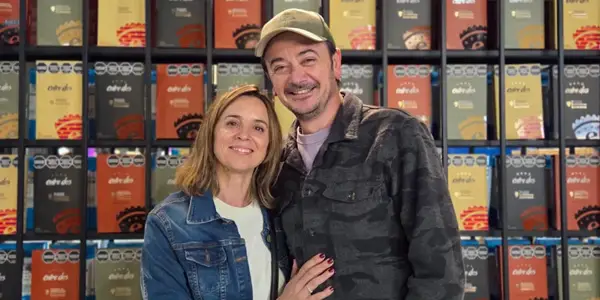
Marc Serra leads IT at Altura. He talks about how LoadIQ was built during COVID, why people own every loading decision, and what he has learned about aviation.
About Marc
How did you get into aviation?
Aviation was an industry I had always been curious about. I’ve worked across sport, tourism, digital commerce and startups, and before Altura I spent seven years at FC Barcelona as Head of Digital Commerce, which gave me a strong background in digital transformation, retail, payments and customer experience.
Altura was a chance to step outside my comfort zone and apply that experience in a more complex, international environment. Aviation is operationally intense and highly regulated, with very little room for failure, and that challenge is what attracted me.
What does your role involve?
My job is to strengthen Altura’s technology capabilities and make the business more scalable and data-driven. That means making sure our systems, processes and platforms can support growth, and helping the business see how technology creates value through operational efficiency, better customer solutions, stronger data visibility and the responsible use of AI.
Part of my week goes on technology strategy, data, AI, systems and governance. The rest is spent with our operational and commercial teams, understanding what they need and building solutions for existing customers and new opportunities. The most rewarding part is connecting technology with real business impact.
How does aviation retail differ from the high street?
The biggest difference is operational complexity. On the high street you normally have stable stores, fixed infrastructure and predictable connectivity. In aviation retail, warehouses can be smaller, payment connectivity can be limited, operations vary by airport and country, and payment rules differ across markets. Solutions have to work reliably in very challenging conditions, so you are always thinking about contingencies, resilience and scale, and technology and operations have to work very closely together.
Where did LoadIQ come from?
It goes back to 2020. During COVID, flight schedules collapsed practically overnight. Some airlines stopped flying completely and others ran a handful of routes. Loading had relied on stable patterns such as historical demand, recurring schedules and experience from similar routes, and those patterns disappeared. We needed a more dynamic, data-driven way to decide what to load, when to replenish, and how to avoid both waste and missed sales.
No ready-made solution worked the way we needed. Some providers focused on periodic optimisation or theoretical forecasting, and we needed something much closer to the live operation, so we built the first version ourselves. It started as a forecasting tool using sales data, flight schedules, passenger expectations and loading information. The people building it worked alongside the people running the operation, so every limitation and exception was picked up and improved quickly.
As flying recovered, the challenge moved from surviving disruption to optimising performance at scale. We added more data, improved forecast accuracy and introduced machine learning that adapts to the route, airline, product category and operational context. LoadIQ has grown from a forecasting tool into a decision service that improves availability, reduces waste and saves handling costs.
How does LoadIQ work?
It starts with one practical question: what is the right loading decision for each flight, balancing product availability, operational efficiency, handling cost and the airline’s commercial priorities?
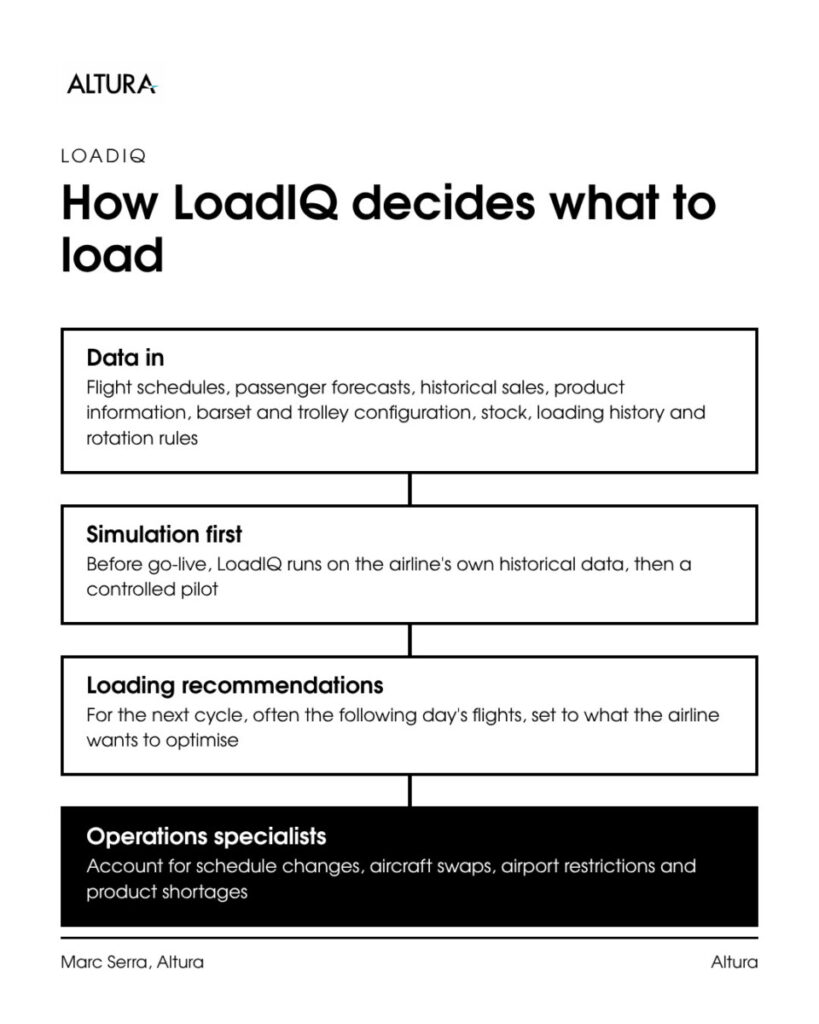
LoadIQ brings together flight schedules, passenger forecasts, historical sales, product information, barset and trolley configuration, stock data, loading history, rotation rules and airline-specific constraints. Flights, routes, passengers, sales and product data are needed from day one. Stock, waste and crew feedback enrich the model over time, and where data is missing or delayed, LoadIQ uses historical patterns and simulations until better data is available.
It then produces loading recommendations for the next cycle, often the following day’s flights, based on what the airline wants to optimise, whether that is profitability, cost savings, availability, waste reduction or operational simplicity.
Before going live, we run a simulation on the airline’s historical data. It shows what LoadIQ would have recommended against what actually happened, and the expected effect on handling costs, catering touches, availability, waste and commercial performance. We then usually move to a controlled pilot before scaling.
Why do people stay involved in every decision?
Combining AI with human expertise is a permanent part of how LoadIQ works, because aviation operations are too dynamic and too commercially important to leave to an autonomous system. AI can work through thousands of combinations of flights, passenger loads, sales, routes, seasonality, stock and rotation rules every day, which no planner could do by hand.
Aviation is also full of disruption that doesn’t show up cleanly in the data, such as last-minute schedule changes, aircraft swaps, airport restrictions and product shortages. Our operations specialists account for these real-world factors and exceptions, and their insights help the system learn and improve over time.
Airlines trust AI when they see how it performs in their own operation, which is why we use simulations, pilots, baselines and transparent reporting. People design the strategy and own the decision, and machines process the complexity at scale.
What is it like working at Altura?
You see the impact of your work very directly. If you propose an idea or improve a process, you usually see the effect quickly in the operation, with our teams and with airline customers.
The IT team has people from Kazakhstan, Romania, Argentina, Spain, Peru and the UK, and across the company there are more than 20 nationalities. The culture is collaborative and close, and people get involved when something important needs delivering.
With the Circles model we work around missions, bringing together people from different parts of the business to solve specific problems, which brings IT closer to the real business challenges. Our work on Copilot and AI adoption is a good example. The aim is to help the whole organisation become AI-ready, and Circles give people the space to test ideas and share use cases.
What do you do outside work?
I like spending time with my wife and our dog, going for walks and being outdoors. We live near Barcelona, so the beach and the mountains are close. I used to play padel and want to get back to it soon.
What would you say to someone starting out in aviation technology?
Don’t worry if everything feels complicated at first, because it is. Stay curious, ask questions and understand why things are done a certain way before trying to change them. Spend time close to the operation and the customer, and keep things simple. In aviation the best solutions make a difficult process easier for everyone involved.